Certificates of Analysis available upon request.
Editorial coverage of mechanism, methodology, and handling. Written for researchers who require precision before they order.
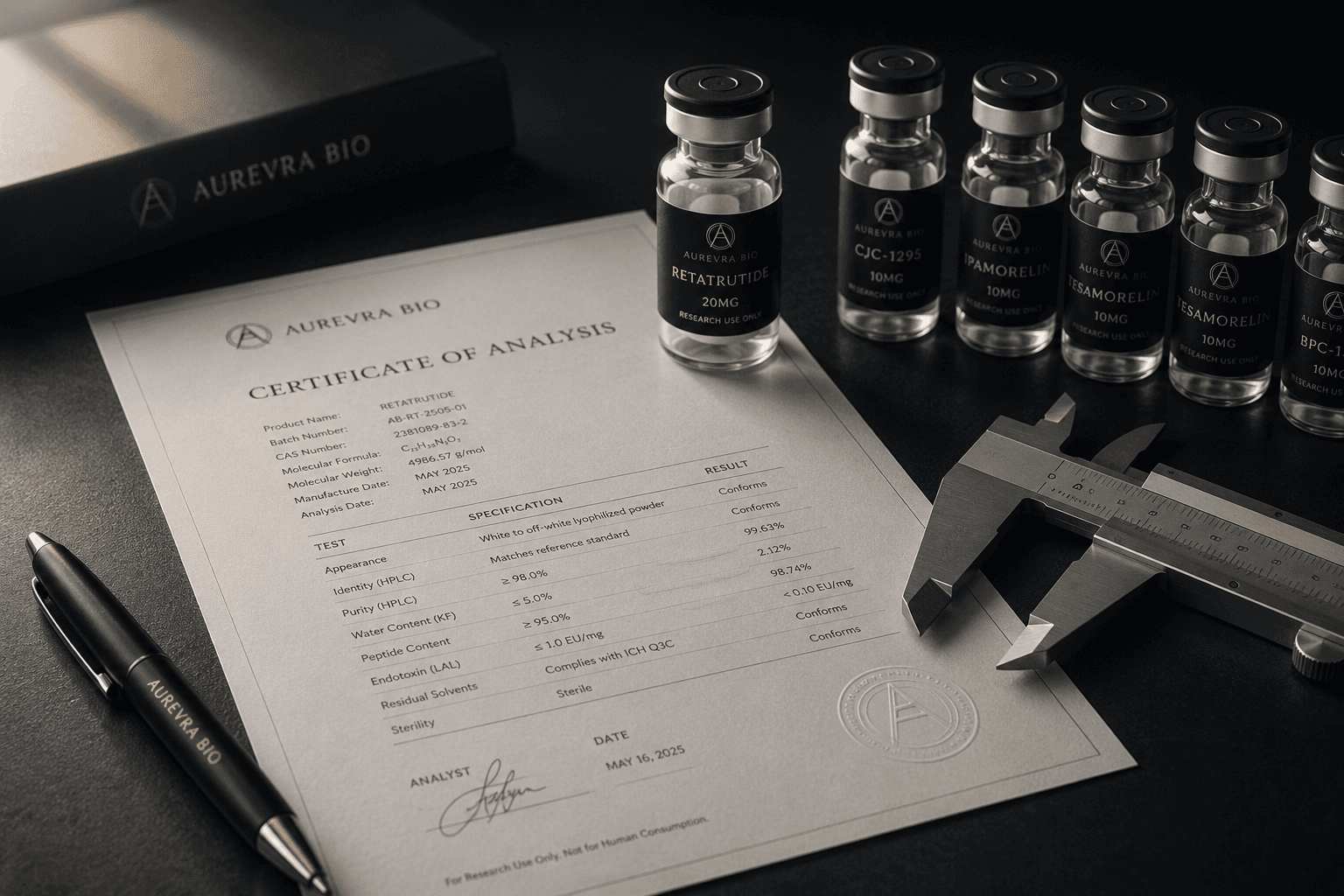
Quality standards
Identity, purity, methodology, batch reference. A plain-language guide to reading the Certificate of Analysis that documents every Aurevra Bio compound. Available upon request.
Composition research
An overview of the pharmacology, published literature, and analytical considerations for triple receptor agonist research.
Laboratory handling
Best practices for handling lyophilized research compounds in a controlled laboratory environment, including organization, documentation, and proper research procedures.
Recovery research
BPC-157 and TB-500 are frequently paired in the research-peptide market. The published literature describes two structurally and mechanistically unrelated compounds — and "TB-500" itself is a less precise term than most sources treat it as.
KPV is studied as an isolated fragment because a specific published finding shows its anti-inflammatory activity survives separation from alpha-MSH, while the receptor-binding activity responsible for the parent hormone's other effects does not.
Longevity research
MOTS-c and SS-31 are routinely grouped together as "mitochondrial peptides." Their mechanisms, research models, and regulatory histories are entirely different — including one specific, narrow FDA approval that belongs to a drug product, not to a compound name.