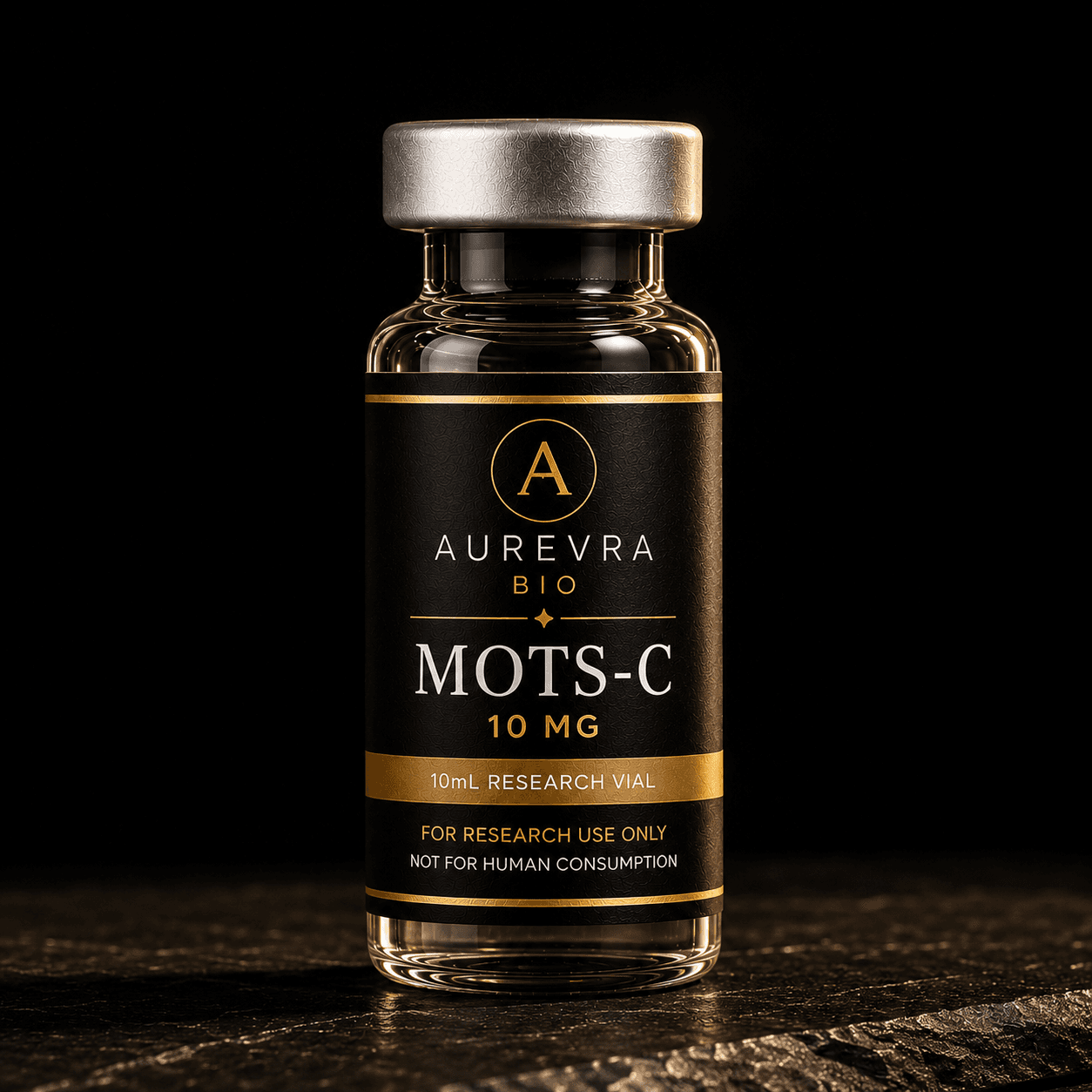
MOTS-c and SS-31 are routinely discussed together as “mitochondrial peptides,” but grouping them that way obscures more than it explains. One is a research-stage peptide encoded by the mitochondrial genome itself, studied so far only in cells and rodents. The other, under its pharmaceutical name, is the active ingredient in a drug the FDA has actually approved — for one narrow, specific indication, under a pathway that still requires confirmatory evidence. Treating the two as interchangeable, or treating that approval as though it validates either compound more broadly, misrepresents both. This is what each compound is, how they work, and exactly what their evidence bases do and don’t establish.
What MOTS-c is
MOTS-c is a 16-amino-acid peptide encoded within the mitochondrial genome itself — specifically, a short open reading frame within the gene for 12S ribosomal RNA. Lee et al. (2015) first characterized it, reporting that intraperitoneal MOTS-c injection in high-fat-diet mice prevented diet-induced obesity and insulin resistance, with measurable effects on fat mass, fasting glucose, and insulin sensitivity.
What SS-31 / elamipretide is
SS-31 — known in its pharmaceutical development as elamipretide — is a synthetic tetrapeptide with alternating cationic and aromatic residues, designed to concentrate in the mitochondrial inner membrane. Unlike MOTS-c, it is not encoded by any genome; it is a laboratory-designed molecule built specifically to target mitochondrial membranes.
Structural and localization differences
The two compounds don’t just differ in sequence — they operate in different cellular locations. MOTS-c, once synthesized, can translocate from the mitochondria to the nucleus under metabolic stress, where it is reported to influence expression of stress-adaptation genes. SS-31 stays at the mitochondrial inner membrane, where its alternating charge pattern lets it concentrate there relative to the surrounding cytosol, rather than moving between cellular compartments the way MOTS-c does. One is a mobile signaling molecule; the other is a membrane-associated molecule that acts locally, in place.
MOTS-c mechanism — AICAR/AMPK signaling
MOTS-c’s best-characterized mechanism runs through cellular energy sensing. Wan et al. (2023), reviewing the mechanistic literature, describe MOTS-c as targeting the folate-methionine cycle and its tethered de novo purine biosynthesis pathway; blocking that pathway raises levels of AICAR, a purine biosynthesis intermediate that itself acts as an AMP mimetic, directly activating AMPK. That activation — the same cellular energy-sensing pathway exercise and caloric restriction are reported to trigger — is described as MOTS-c’s route to downstream effects on energy metabolism, reported through SIRT1 and PGC-1α signaling.
SS-31 mechanism — cardiolipin and mitochondrial membrane biology
SS-31’s mechanism is structural rather than signaling-based. Mitchell et al. (2020) reported that SS-31 partitions into the mitochondrial membrane’s interfacial region and binds cardiolipin — the phospholipid that organizes the electron transport chain complexes — with particular affinity for cardiolipin’s doubly-anionic form. The peptide reduces the membrane’s surface charge without destabilizing its structure, and reduces interfacial calcium accumulation implicated in mitochondrial stress. This is a direct biophysical interaction with a specific membrane lipid, not a signaling cascade.
Research models and evidence base
The two compounds’ evidence bases diverge sharply in scope, not just in mechanism. MOTS-c’s literature is preclinical throughout — cell culture and mouse models, including the original 2015 characterization’s intraperitoneal-injection, high-fat-diet mouse design — with no published human clinical trials and no FDA approval of any kind, for any indication. Elamipretide’s literature is broader: alongside the membrane-biophysics work described above, it has been studied directly in humans, including the TAZPOWER trial, which measured knee extensor muscle strength in Barth syndrome patients and became the basis for a real, specific FDA drug approval — detailed in full below. That is a materially different evidence base than MOTS-c’s, not a difference of degree.
What the evidence does and does not establish
None of the above establishes that MOTS-c and elamipretide are interchangeable, or that either compound’s research supports a claim about the other. MOTS-c’s AICAR/AMPK mechanism and elamipretide’s cardiolipin-binding mechanism are unrelated biochemical events; nothing in either compound’s literature studies them together or claims a shared effect. Elamipretide’s regulatory approval — detailed next — applies to one specific drug product, for one specific rare disease, evaluated on one specific muscle-strength endpoint; it does not establish that elamipretide is safe or effective for any other use, and it says nothing about MOTS-c whatsoever.
Regulatory context: Forzinity / elamipretide
Elamipretide, also known as SS-31 in the research literature, is the active ingredient in Forzinity, a drug that received FDA accelerated approval on September 19, 2025. Per FDA’s own announcement, the approved indication is narrow and specific: to improve muscle strength in adult and pediatric patients with Barth syndrome — a rare, life-limiting genetic mitochondrial disease — weighing at least 30 kg. The approval was based on improvement in knee extensor muscle strength observed in the TAZPOWER trial, an intermediate clinical endpoint; because it was granted under the accelerated approval pathway, continued approval may be contingent on verification of clinical benefit in a confirmatory trial. FDA describes Forzinity as working by binding to the mitochondrial inner membrane and stabilizing cardiolipin.
That approval belongs to Forzinity as a specific, FDA-regulated drug product — reviewed and approved as a complete package covering manufacturing, formulation, and the Barth syndrome indication specifically — not to the compound name in the abstract. It does not establish that MOTS-c has any regulatory status, which it does not. It does not establish elamipretide’s safety or effectiveness for any use beyond the approved Barth syndrome indication. And a material sold in the research-peptide market under the name “SS-31” is not itself an FDA-approved drug: only Forzinity, as reviewed and approved by FDA, carries that status.
Research-use considerations
Aurevra supplies MOTS-c as two research SKUs — 10mg and 20mg — verified the same way as every compound in the catalog. SS-31/elamipretide is not part of Aurevra’s catalog. For MOTS-c specifically, the absence of any human trial history or regulatory review makes independent identity and purity verification the only real check available — there is no drug label or regulatory filing to cross-reference the way there now is for elamipretide. Aurevra issues a batch-specific Certificate of Analysis for every lot upon request — see what a COA actually tells you for what that document verifies, and our Sourcing & Quality Standards page for the testing methodology behind it.
Conclusion
MOTS-c and SS-31 end up in the same sentence constantly because both are described, loosely, as “mitochondrial peptides.” Once the mechanisms, research models, and regulatory histories are laid out separately, the label is about the only thing they share. Understanding each on its own terms — rather than borrowing credibility or evidence from one to describe the other — is the more accurate way to read the literature on either.
For research use only. This article describes documented pharmacology, published research findings, and public regulatory history — it does not constitute a recommendation for any human or veterinary use, and it does not establish that MOTS-c produces any effect in humans.
- [1] Lee C, Zeng J, Drew BG, et al.. The mitochondrial-derived peptide MOTS-c promotes metabolic homeostasis and reduces obesity and insulin resistance. Cell Metabolism, 21(3):443–454, 2015. doi:10.1016/j.cmet.2015.02.009
- [2] Wan W, Zhang L, Lin Y, Rao X, Wang X, Hua F, Ying J. Mitochondria-derived peptide MOTS-c: effects and mechanisms related to stress, metabolism and aging. Journal of Translational Medicine, 21:36, 2023. doi:10.1186/s12967-023-03885-2
- [3] Mitchell W, Ng EA, Tamucci JD, et al.. The mitochondria-targeted peptide SS-31 binds lipid bilayers and modulates surface electrostatics as a key component of its mechanism of action. Journal of Biological Chemistry, 295(21):7452–7469, 2020. doi:10.1074/jbc.RA119.012094
- [4] U.S. Food and Drug Administration. FDA Grants Accelerated Approval to First Treatment for Barth Syndrome. FDA News Release, 2025. Source