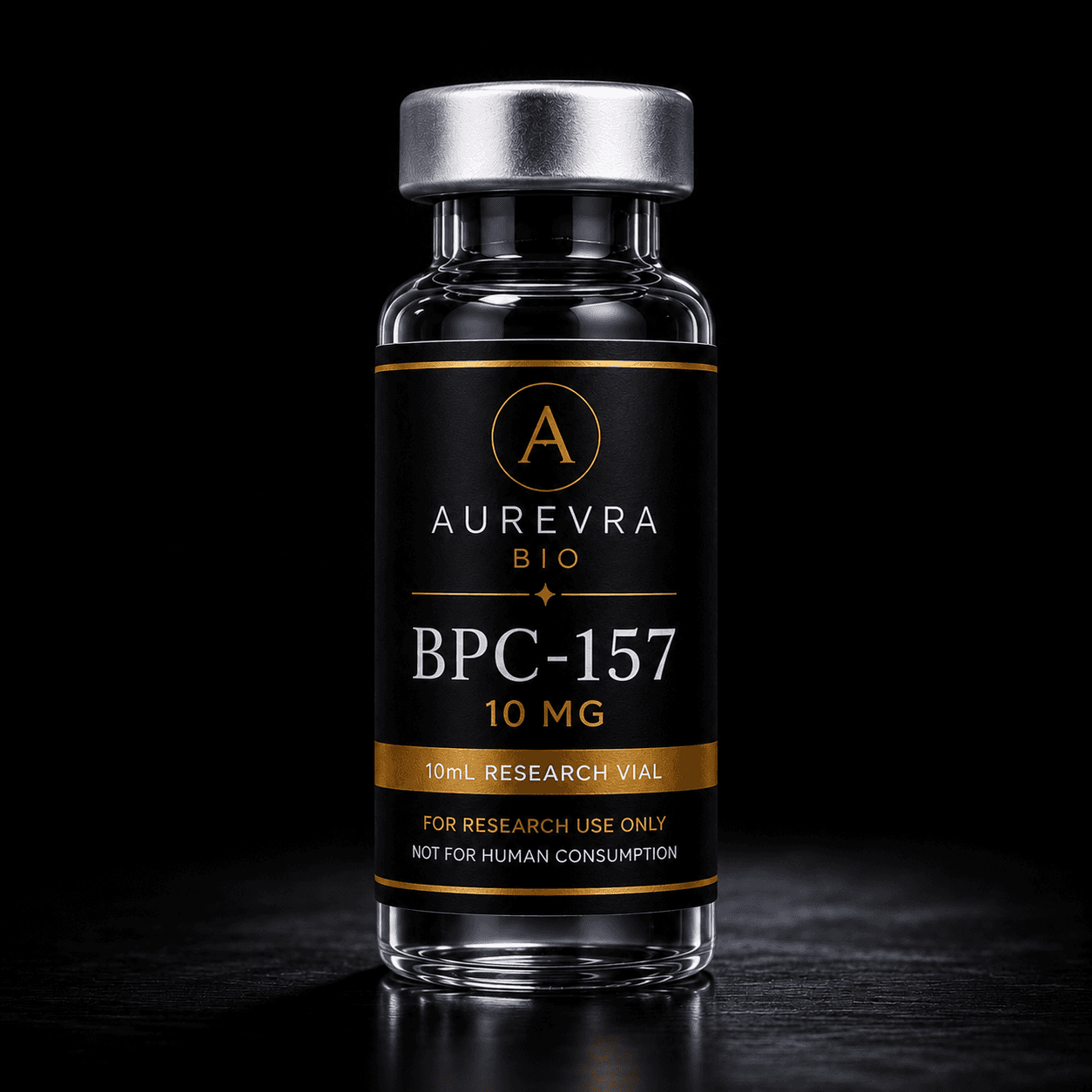
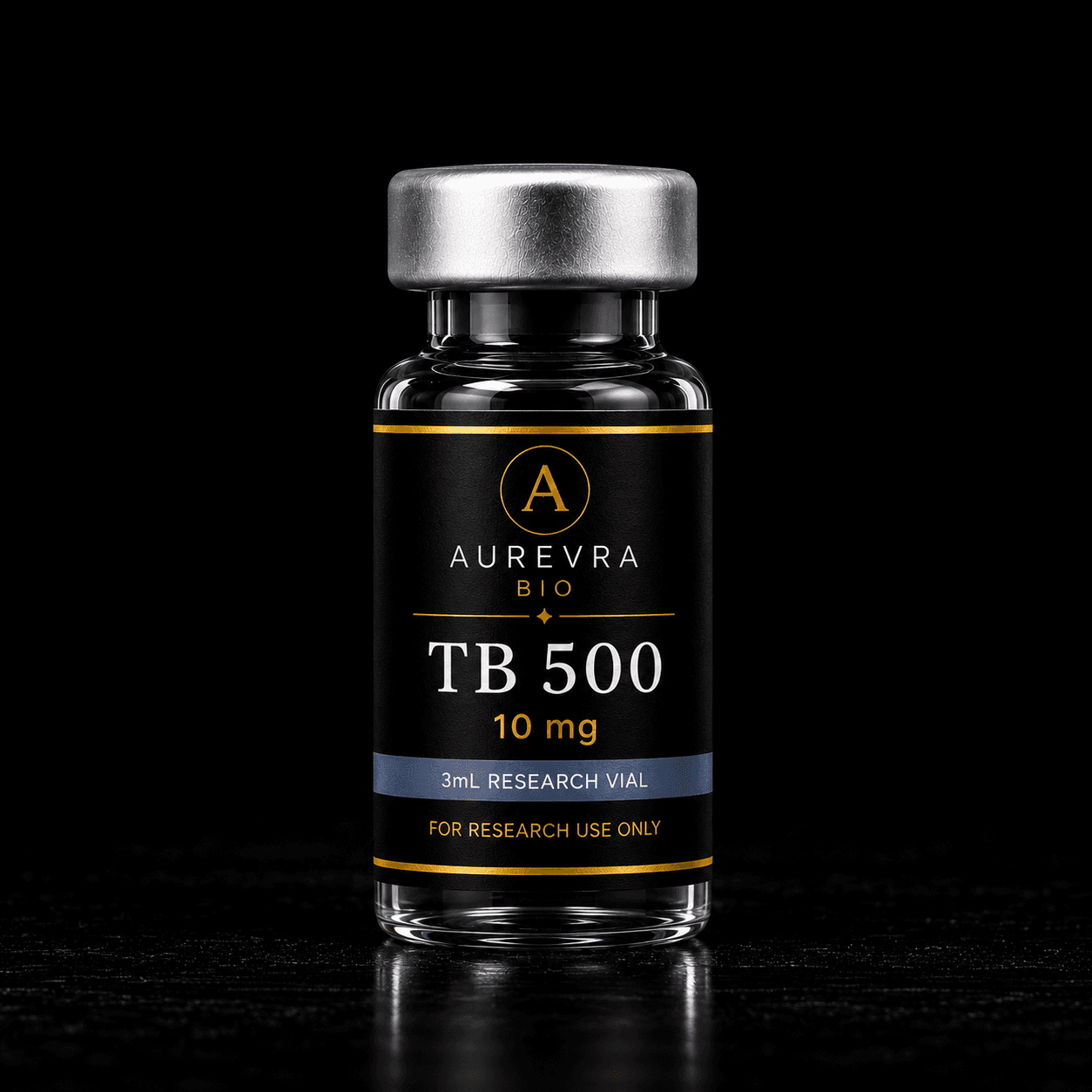
BPC-157 and TB-500 are frequently sold and discussed together, often on the assumption that they work through a shared “healing” mechanism. The published literature doesn’t support that framing. These are two structurally and mechanistically distinct compounds — one studied for a receptor-mediated angiogenic signaling role, the other for a direct structural role in actin regulation — that happen to both fall under tissue-repair research. This is a comparison of what each compound actually is, what has been studied, and where the terminology itself introduces more ambiguity than most sources acknowledge.
What each compound actually is
BPC-157 is a synthetic pentadecapeptide — a 15-residue sequence (Gly-Glu-Pro-Pro-Pro-Gly-Lys-Pro-Ala-Asp-Asp-Ala-Gly-Leu-Val) derived from a partial sequence identified in human gastric juice. Its research literature is dominated by one group, led by Predrag Sikiric at the University of Zagreb, which has published the large majority of the preclinical work on this compound since the 1990s.
“TB-500,” by contrast, is not the name of a molecule studied under that name in the peer-reviewed literature. The peer-reviewed literature studies thymosin beta-4 (Tβ4) — a naturally occurring 43-amino-acid protein — and, more specifically, the short actin-binding fragment derived from it. A 2026 scoping review of this exact terminology (McGuire et al.) found that “TB-500” is used inconsistently across sources: sometimes applied to the short synthetic fragment, sometimes used as a loose synonym for Tβ4 itself. That inconsistency isn’t a minor labeling issue — it means two sources both citing “TB-500 research” may not be referring to the same molecule.
Structural differences
BPC-157’s own designation in the literature — “stable gastric pentadecapeptide BPC 157” — reflects a defining property: unlike most peptides of comparable size, it remains intact in gastric acid rather than degrading quickly.
Thymosin beta-4 is 43 residues. The fragment marketed as TB-500 corresponds to a short acetylated sequence within it — commonly cited as residues 17–23 (Ac-LKKTETQ) — the same region early actin-biochemistry work identified as the actin-binding domain. The full protein and the short fragment are related but are not the same molecule, and they have not been shown to behave identically.
Mechanism: two unrelated pathways
Mechanistic work on BPC-157 has centered on the vascular endothelial growth factor receptor 2 (VEGFR2) pathway. Hsieh et al. (2017) reported that BPC-157 upregulated VEGFR2 expression and promoted its internalization in a rat hind-limb ischemia model, associated with activation of the VEGFR2–Akt–eNOS signaling axis and increased vessel density both in vivo and in cultured endothelial cells. Separately, Chang et al. (2014) reported that BPC-157 increased growth hormone receptor expression in tendon fibroblasts isolated from rat Achilles tendon, in a dose- and time-dependent manner.
The foundational mechanistic work on thymosin beta-4 (Goldschmidt-Clermont et al., 1992) established that it binds G-actin monomers in a 1:1 complex and inhibits nucleotide exchange on the bound actin — the core biochemical basis for its role as an actin-sequestering protein. Later work (Ryu et al., 2014) identified thymosin beta-4 as a target of hypoxia-inducible nitric oxide and HIF-1α regulation, linking it to hypoxic-response signaling in addition to its structural role.
These are not variations on one shared pathway. BPC-157’s studied mechanism is receptor-mediated angiogenic signaling. Thymosin beta-4’s studied mechanism is direct biophysical regulation of the actin cytoskeleton. Nothing in the primary literature connects the two.
Research models: what has actually been studied
BPC-157’s evidence base is almost entirely rodent — rat tendon, muscle, and gastrointestinal-tissue models, concentrated in one research group’s output.
Thymosin beta-4’s evidence base is broader in one specific respect: RegeneRx Biopharmaceuticals sponsored human clinical trials of the full-length recombinant protein, including Phase 3 trials for dry eye disease and neurotrophic keratitis, and a topical-gel program studied in dermal wound conditions. This is worth stating plainly because it cuts against the usual assumption: the compound with real human trial history is the full 43-residue protein under clinical development, not the short fragment sold in the research-peptide market as “TB-500.” McGuire et al. (2026) — searching PubMed, Europe PMC, and ClinicalTrials.gov directly — found direct evidence on “TB-500” specifically limited to a single included study. Whether the short fragment behaves the same way as the full protein, at research-market doses and purity, has not been established.
What the evidence actually shows
For BPC-157: an extensive preclinical literature describing angiogenic and receptor-expression effects in rodent tissue-repair models, with limited independent replication outside the primary research group, and no FDA-approved indication for any use.
For thymosin beta-4: the actin-sequestration mechanism is well established and widely replicated within general cell biology, independent of any peptide vendor. Human clinical trial history exists for specific indications under the full peptide — but published data specifically on the short “TB-500” fragment, at the form and purity sold for research, is not established to the same degree.
Where online claims exceed the evidence
Three patterns show up repeatedly across vendor and forum content on both compounds, and none of them hold up against the primary literature: treating “TB-500” and “thymosin beta-4” as interchangeable, when the specific short fragment’s own pharmacology has not been independently established the way the shared name implies; extrapolating directly from rat tendon or gastrointestinal studies to claims about human injury recovery, which the underlying studies do not themselves claim; and treating “often stacked together” as evidence of proven combined effect, when no controlled study of the combination appears in either compound’s literature.
Why they’re studied together anyway
Both compounds are categorized within tissue-repair research, and their proposed mechanisms are described — informally, not in a comparative study — as complementary: one localized and receptor-driven, one distributed and structural. That framing is common enough in the research-peptide market that it’s worth naming plainly as a market and research-community pattern, not a demonstrated synergistic mechanism. Aurevra supplies both compounds, alongside GHK-Cu and KPV, as components of Klow — a combined formulation, not a claim that the combination has been studied as a unit.
Research-use considerations
The terminology ambiguity around “TB-500” makes independent identity verification more important than it would be for a compound with one universally agreed sequence. Aurevra issues a batch-specific Certificate of Analysis for every lot upon request — see what a COA actually tells you for what that document verifies, and our Sourcing & Quality Standards page for the testing methodology behind it.
For research use only. This article describes documented pharmacology and the current state of the published literature — it does not constitute a recommendation for any human or veterinary use, and it does not establish that either compound produces any effect in humans.
- [1] Seiwerth S, Milavic M, Vukojevic J, et al.. Stable Gastric Pentadecapeptide BPC 157 and Wound Healing. Frontiers in Pharmacology, 12:627533, 2021. doi:10.3389/fphar.2021.627533
- [2] Hsieh MJ, Liu HT, Wang CN, et al.. Therapeutic potential of pro-angiogenic BPC157 is associated with VEGFR2 activation and up-regulation. Journal of Molecular Medicine (Berl), 95(3):323–333, 2017. doi:10.1007/s00109-016-1488-y
- [3] Chang CH, Tsai WC, Hsu YH, Pang JHS. Pentadecapeptide BPC 157 Enhances the Growth Hormone Receptor Expression in Tendon Fibroblasts. Molecules, 19(11):19066–19077, 2014. doi:10.3390/molecules191119066
- [4] Goldschmidt-Clermont PJ, Furman MI, Wachsstock D, Safer D, Nachmias VT, Pollard TD. The control of actin nucleotide exchange by thymosin beta 4 and profilin. A potential regulatory mechanism for actin polymerization in cells. Molecular Biology of the Cell, 3(9):1015–1024, 1992. doi:10.1091/mbc.3.9.1015
- [5] Ryu YK, Kang JH, Moon EY. The Actin-Sequestering Protein Thymosin Beta-4 Is a Novel Target of Hypoxia-Inducible Nitric Oxide and HIF-1α Regulation. PLoS ONE, 9(10):e106532, 2014. doi:10.1371/journal.pone.0106532
- [6] McGuire F, Hughes E, Maak T, Cushman DM. Thymosin Beta-4 and TB-500 in Tissue Healing, Regeneration, and Musculoskeletal Repair: A Scoping Review. Applied Sciences, 16(12):6202, 2026. doi:10.3390/app16126202