KPV is a three-amino-acid fragment of a much larger, well-studied hormone — and the reason researchers investigate it on its own, rather than the parent hormone, is a specific, published finding: its anti-inflammatory activity survives that isolation, while the receptor-binding activity responsible for the parent hormone’s other effects does not. This is what KPV actually is, what has been studied, and what the evidence does and doesn’t establish.
What KPV actually is
KPV is a tripeptide — lysine, proline, valine — corresponding to the C-terminal three residues (positions 11–13) of alpha-melanocyte-stimulating hormone (alpha-MSH), a 13-residue hormone (Ser-Tyr-Ser-Met-Glu-His-Phe-Arg-Trp-Gly-Lys-Pro-Val) best known for its role in skin pigmentation, acting through melanocortin receptors.
Its relationship to alpha-MSH
The sequence most often cited as necessary for melanocortin-receptor binding and pigmentary activity is His-Phe-Arg-Trp — residues 6–9, near the middle of the hormone. KPV sits at the opposite end of the molecule, outside that core. Getting, Schiöth, and Perretti (2003) tested this distinction directly, in a mouse crystal-induced peritonitis model and cultured macrophages: KPV reduced inflammatory cell accumulation and macrophage cytokine release to a degree comparable with both full-length alpha-MSH and the core His-Phe-Arg-Trp sequence. But unlike the core sequence, KPV did not increase cAMP, and its effect was not blocked by a melanocortin-3/4 receptor antagonist — the study’s authors proposed inhibition of interleukin-1β activity as the more likely route. That combination is what establishes KPV’s anti-inflammatory activity as mechanistically distinct from the melanocortin-receptor signaling alpha-MSH itself depends on, not simply a smaller dose of the same effect.
Mechanism: what the literature describes
The most detailed mechanistic work on KPV comes from intestinal-inflammation research. Dalmasso et al. (2008), publishing in Gastroenterology, reported that nanomolar concentrations of KPV inhibited NF-κB activation and MAP kinase signaling in cultured human intestinal epithelial cells and immune cells, and reduced secretion of multiple pro-inflammatory cytokines, including IL-8, IL-6, IL-12, IFN-γ, TNF-α, and IL-1β. The same study identified PepT1 — a peptide transporter expressed on intestinal epithelial cells and T cells — as KPV’s route into the cell, establishing a specific transport mechanism rather than passive diffusion.
Research models: what has actually been studied
KPV’s evidence base is preclinical throughout: cultured human intestinal epithelial cells and T cells, and two mouse models of colitis — DSS-induced and TNBS-induced — in Dalmasso et al.; a mouse peritonitis model and cultured macrophages in Getting et al. In the colitis models, orally administered KPV reduced weight loss, lowered myeloperoxidase activity (a marker of neutrophil infiltration), improved tissue histology, and reduced pro-inflammatory cytokine mRNA in colon tissue, relative to untreated controls.
Preclinical versus human evidence
No published human clinical trials of KPV exist, and it does not carry FDA approval for any indication. In 2026, an FDA advisory committee reviewed KPV for inclusion on the Section 503A Bulks List — a compounding-pharmacy ingredient list, not a drug-approval pathway — and the review reportedly found no human exposure data for KPV administered by any route. The committee’s vote was advisory; it did not constitute approval of any kind. Every finding described above — the receptor-independence result, the NF-κB and cytokine data, the colitis-model outcomes — comes from cell culture and rodent studies.
Where online claims exceed the evidence
Two patterns are common in vendor and forum content on KPV, and neither holds up against the published literature: describing KPV’s activity as though it were simply a smaller dose of alpha-MSH’s broader hormonal effects, when the entire point of the Getting et al. finding is that the two are mechanistically distinct; and treating rodent colitis-model outcomes as though they describe an effect in a person, when no human trial has tested that.
KPV as a component of Klow
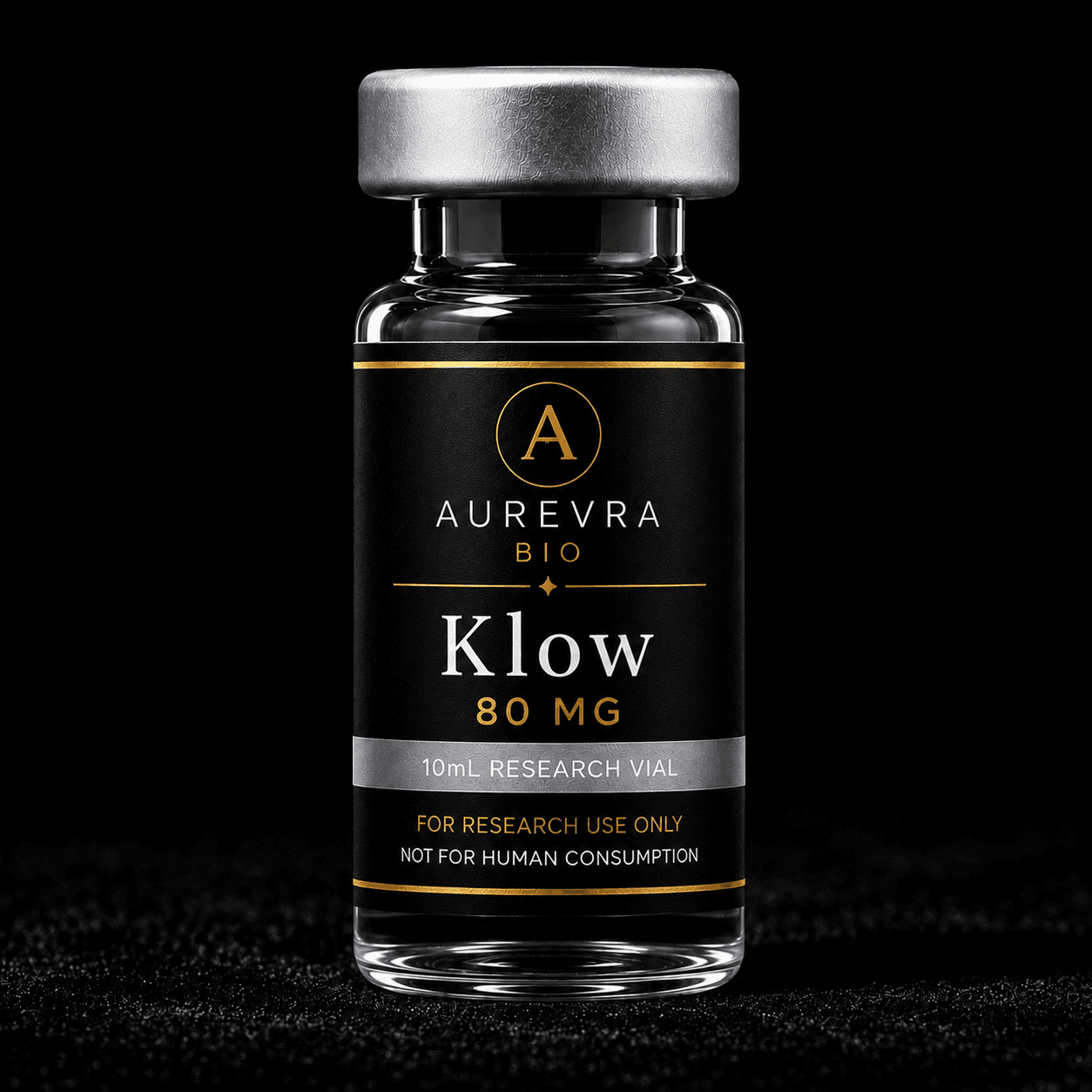
Aurevra supplies KPV as one of four components in Klow 80mg, alongside BPC-157, TB-500, and GHK-Cu — see our comparison of BPC-157 and TB-500 for two of the other three. KPV is the least independently documented of the four: it is not sold as a standalone Aurevra product, and its research base is smaller and narrower than the others’. That’s a reason to understand it on its own terms, not to treat it as interchangeable with better-studied compounds because it ships in the same vial.
Research-use considerations
KPV’s status as a fragment rather than a standalone, independently regulated compound makes identity and sourcing documentation worth the same scrutiny as any other research material. Aurevra issues a batch-specific Certificate of Analysis for every lot upon request — see what a COA actually tells you for what that document verifies, and our Sourcing & Quality Standards page for the testing methodology behind it.
For research use only. This article describes documented pharmacology and the current state of the published literature — it does not constitute a recommendation for any human or veterinary use, and it does not establish that KPV produces any effect in humans.
- [1] Dalmasso G, Charrier-Hisamuddin L, Nguyen HTT, Yan Y, Sitaraman S, Merlin D. PepT1-mediated tripeptide KPV uptake reduces intestinal inflammation. Gastroenterology, 134(1):166–178, 2008. doi:10.1053/j.gastro.2007.10.026
- [2] Getting SJ, Schiöth HB, Perretti M. Dissection of the anti-inflammatory effect of the core and C-terminal (KPV) alpha-melanocyte-stimulating hormone peptides. Journal of Pharmacology and Experimental Therapeutics, 306(2):631–637, 2003. doi:10.1124/jpet.103.051623